Conjunctions Sold
The Judge's Dance
Seven bodies orbit a pale sun while, beneath them, the dancing goes on.
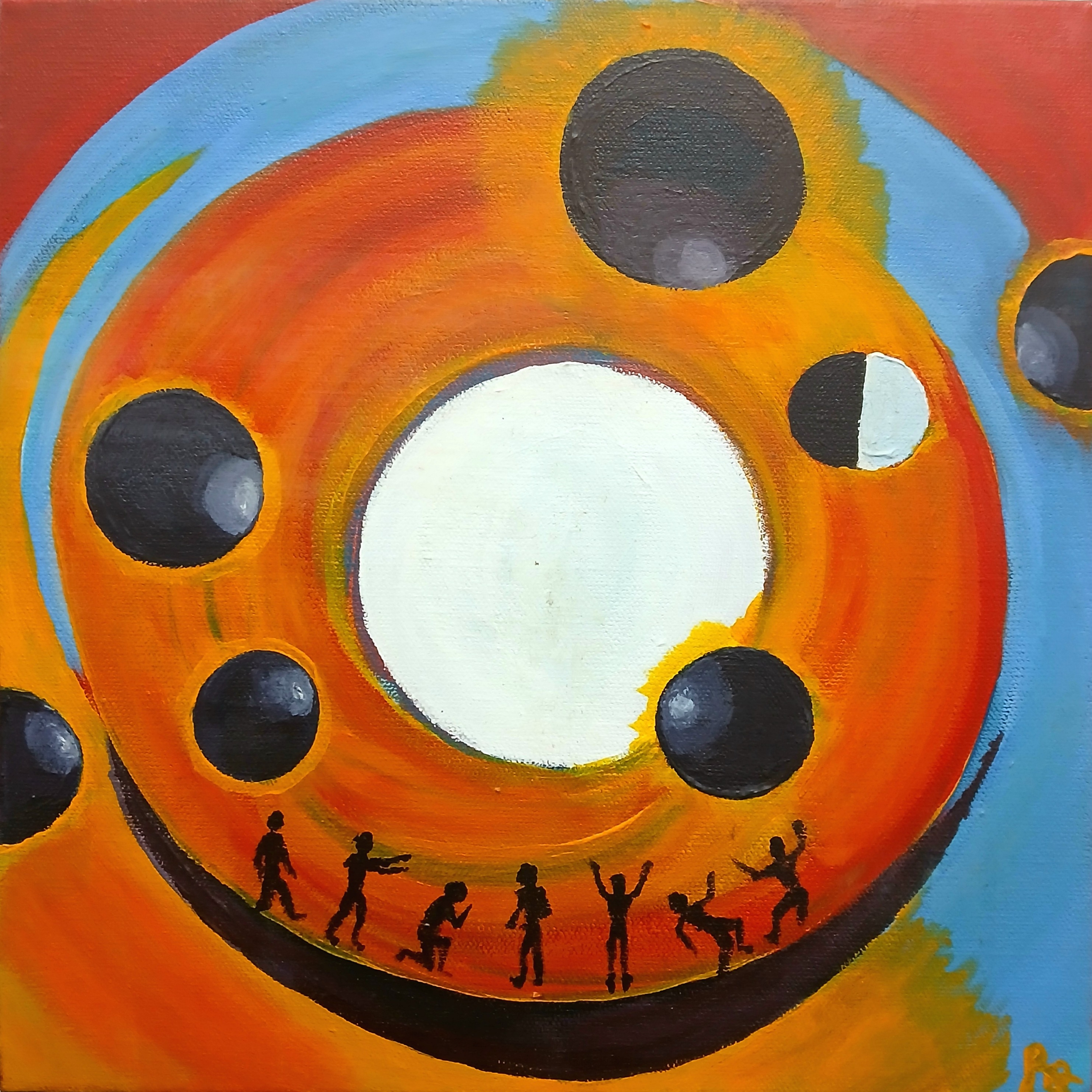
The Judge’s Dance is an abstract response to the closing pages of Cormac McCarthy’s Blood Meridian—not an illustration of them. There is no figure of the Judge here, only the gravity he exerts. The pale orb at the center holds the composition the way he holds a room: everything else is in orbit whether it consented or not.
Seven dark bodies circle that center. I think of them as the Glanton gang—satellites with no light of their own, each one lit only on the side facing the thing that governs them. One is split down the middle, half black and half white. That one is the Kid: half given over to what the gang made of him, half stubbornly withholding some last scrap the Judge never gets to have.
The painting began as a muted, archaeological thing—dust, ash, excavated surface—and refused to stay there. It came out in orange, gold, and blue instead, which turned out to be the truer reading. The Judge says the dance is all; a dance is not a somber affair. Along the bottom arc the figures are mid-motion, arms up, kicking, striding. Whether that reads as celebration or as something worse is left to the viewer, which is exactly how the book leaves it.