Abstract art suffers from a peculiar curse: everybody thinks they can spot fraud, but not everybody knows how to spot quality. One person looks at an abstract painting and says, “That’s brilliant.” Another says, “My nephew could do that with a mop and a head injury.” As usual, both may be wrong.
The common mistake is judging abstract work by the standards of representation. People ask what it is “supposed to be,” as if every painting ought to show a horse, a bowl of fruit, or a saint looking mildly inconvenienced by martyrdom. But abstraction is not usually trying to depict an object. It is trying to build an experience through form, color, movement, surface, rhythm, and tension. The real question is not “What does it represent?” The real question is “Does it hold together as a work of art?”
That is where the difference lies between a well-executed abstract work and a poor one.
Intentionality vs. Arbitrariness
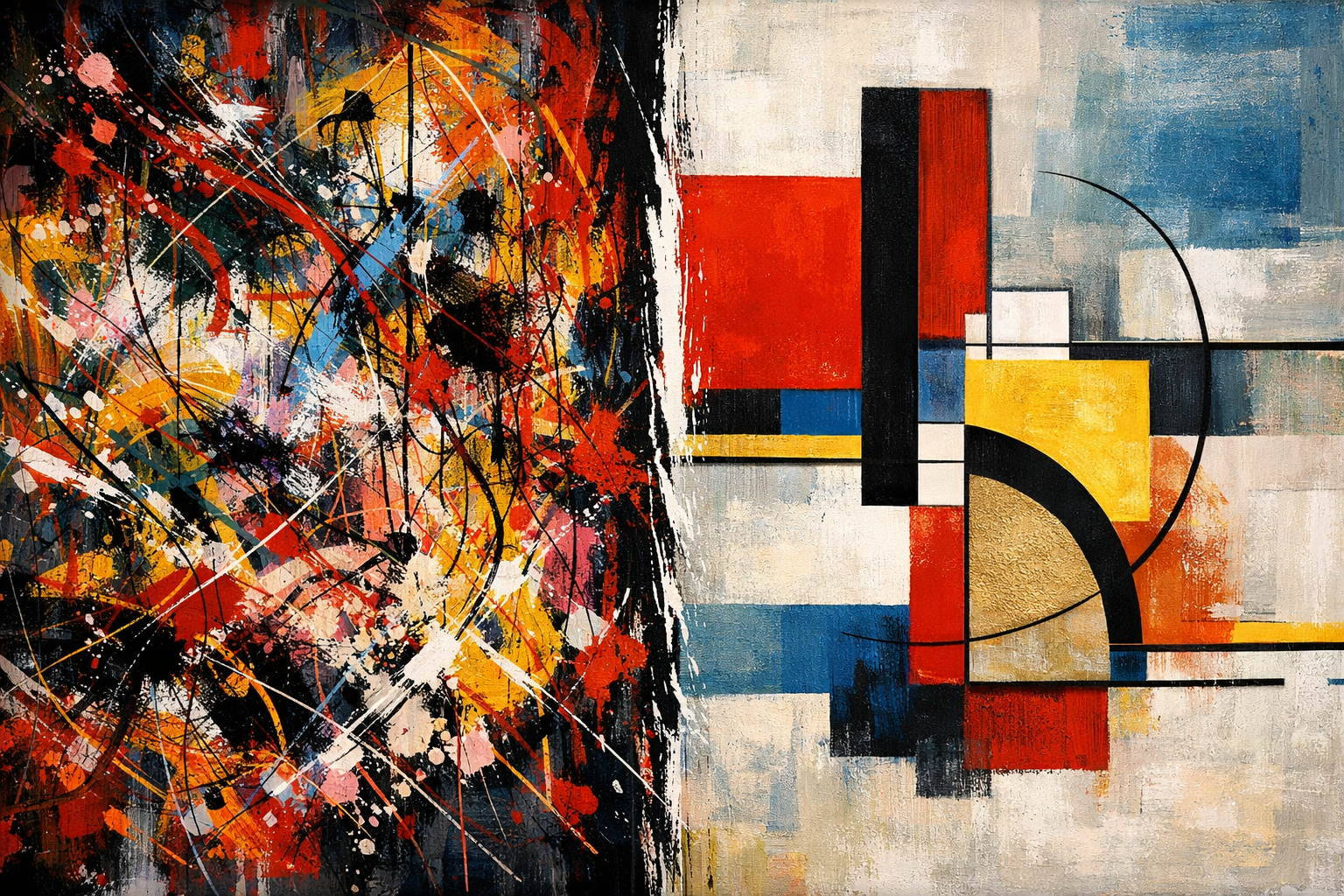
A strong abstract work feels intentional. Not predictable. Not safe. Not tidy. Intentional. It may be wild, raw, ugly, lyrical, violent, meditative, fractured, ecstatic, or severe. But it feels as though the artist made choices for a reason. Those choices relate to one another. The marks speak the same language, even if they argue. The color has a logic. The structure has a pulse. The surface has a purpose.
A weak abstract work, by contrast, feels arbitrary. It is not necessarily bad because it is messy. Plenty of excellent paintings are messy. It is bad when the mess reveals indecision rather than conviction. The composition drifts. The colors do not converse. The marks pile up with no clear hierarchy or necessity. It begins to feel less like a painting and more like evidence that something happened.
Composition
One of the clearest differences is composition. In a well-executed abstract piece, the eye moves with purpose. It may roam, pause, crash, circle back, or ricochet across the surface, but it does not simply wander off and perish in a cul-de-sac. There is visual direction. There is emphasis. There is a sense of weight, pressure, rest, and release. Even if the composition is asymmetrical or unstable, that instability feels deliberate. The artist is controlling the tension rather than merely recording it.
Poorly executed abstraction often has no such structure. Everything is equally loud, which is another way of saying nothing matters. Or everything is equally timid, which is just visual beige in a more expensive outfit. There is no rhythm, no hierarchy, no sense that one area needs another. The painting can look busy without being rich, and activity is not depth. A traffic jam is active. That does not make it a symphony.
Color
Color is another dead giveaway. In strong abstract art, color is not merely chosen—it is organized. Hue, value, saturation, temperature, and contrast are working together to create pressure and meaning. A red beside a black behaves differently than a red interrupted by a chalky grey or cooled by a blue-green field. These are not cosmetic decisions. They shape the emotional and structural force of the work.
In poor abstraction, color often feels impulsive or decorative. It is selected because it seems dramatic, fashionable, or pleasing in isolation, not because it belongs to the larger logic of the painting. A metallic accent or high-contrast scheme may grab attention quickly, but if the color relationships have no deeper structure, the effect wears off fast. The painting seduces at ten feet and collapses at two.
Mark-Making
Mark-making matters just as much. Good marks carry consequence. They show pressure, speed, hesitation, force, revision, or restraint. They feel like part of the painting’s necessity. Weak marks often feel borrowed—gestures performed because they look expressive, not because they are needed. There is a world of difference between a mark that reveals thought and a mark that merely advertises “artist at work.”
Surface
The handling of surface is equally important. Abstract painting lives and dies on material intelligence. Thick passages, thin veils, drag, scrape, stain, drybrush, matte, gloss, exposed ground—these are not side issues. They are part of the structure. They shape how the work breathes. A strong painting uses its materials with specificity. A weak one often has a generic, unconsidered surface that could belong to almost anyone.
Editing
Then there is editing, which is where many paintings either mature or perish. Strong abstract work is edited. That does not always mean simplified. It means the artist has decided what deserves to stay, what should be buried, what must be sharpened, and what needs to be sacrificed. Weak work often preserves too much. Every gesture remains because the artist is afraid to lose evidence of effort. But effort is not the same thing as resolution. A painting improves when unnecessary moves are removed, not when every impulse is embalmed for public viewing.
Spontaneity and Discernment
One of the most common misconceptions in abstract art is the idea that spontaneity excuses everything. It does not. Spontaneity can be powerful, but only when governed by discernment. A good artist knows when an accident has meaning and when it is merely an accident. A poor artist often mistakes randomness for freedom and leaves the canvas littered with evidence of untamed impulse. Freedom without judgment is not liberation. It is just chaos with a flattering press release.
Identity and Presence
What makes a strong abstract work memorable is that it has identity. Something remains after you leave it: a rhythm, a pressure, a color chord, a structural tension, a visual scar. It does not evaporate the moment you turn away. It has a distinct presence. A weak abstract work is often interchangeable. Shift a shape, swap a color, erase a line, add a scribble—nothing essential changes because nothing essential was ever established.
Technique, Emotion, and Necessity
This is why technique alone is not enough. Clean edges, refined glazing, expensive surfaces, and tasteful palettes do not guarantee a good painting. But neither does raw emotion. Feeling deeply while making the work may matter to the artist, but the viewer can only judge what actually made it onto the surface. Emotion must be translated into form. Otherwise, it remains private weather.
A good abstract work transforms choice into necessity. A poor one leaves choice looking random.
Conclusion
That, in the end, is the clearest test. Does the painting feel authored? Does it feel as though it had to become itself? Or does it feel like one version among a thousand interchangeable outcomes? Strong abstraction creates inevitability. Weak abstraction creates leftovers.
Abstract art is not easier because it does not describe the visible world. In many ways, it is harder. It has nowhere to hide. Without recognizable subject matter to lean on, every decision carries more weight. Composition must carry its own body. Color must justify itself. Surface must speak. Rhythm must hold. The work must earn its existence through internal coherence, not borrowed narrative.
So no, the real difference between a well-executed and a poorly executed abstract work is not whether the viewer “gets it.” The difference is whether the painting knows what it is doing.
And the good ones do.